
Milanese Cuisine
Mondeghili Meatballs
Traditional Milanese meatballs. The quintessential dish of recovery cuisine, born in the poor kitchens of 19th-century Milan.
There is a moment, on cold Milanese winter evenings, when the smell of sizzling onion rises from the courtyards of old buildings and stops you in the middle of the street. That smell has a name: mondeghili. They are not simple meatballs. They are an act of memory, a culinary philosophy, the most authentic embodiment of Milanese inventiveness in the face of scarcity. They are, to all intents and purposes, the soul of the city on a plate.
Origins: a word that comes from afar
The name mondeghilo (plural mondeghili, sometimes written mondighili) has ancient and curious roots. It most likely derives from the Spanish albóndiga, which in turn descends from the Arabic al-bunduqa. An etymology that tells us centuries of Spanish domination over the Duchy of Milan — from 1535 to 1706 — and of a cuisine that allowed itself to be contaminated, absorbed, and reinterpreted. The word traveled across the Mediterranean, transformed by word of mouth, and took root in the working-class neighborhoods of Milan.
Historical trivia: The first written mention of mondeghili in a Milanese recipe book dates back to the late 19th century, in Felice Luraschi’s work Nuovo cuoco milanese economico (1853), where they are described as a recovery preparation intended for bourgeois families. A sign that the dish had already crossed social classes, from the courtyard to the dining room.
The “nothing is thrown away” philosophy
Mondeghili are, first and foremost, a recovery recipe. Born in the poor kitchens of 19th-century Milan, they were born from the leftovers of lesso — the mixed boiled meat that every family prepared on Monday to use the bones and less prized cuts. Meat already cooked, shredded, patiently minced, blended with whatever was available. Every family had its own version. Every concierge, every housewife, every grandmother kept a personal variant with the same jealousy as a family secret. At Alla Cadrega, you will taste the recipe of the founder of our family of restaurateurs, Grandma Emilia.
The Ingredients: Tradition and Variants
In the most classic and codified recipe, mondeghili require: Leftover boiled meat (beef, but also chicken or tongue), Milan salami to give body and fat, Stale bread soaked in milk, Eggs, Grana Padano grated cheese, Garlic, parsley, nutmeg, salt, and pepper, Quality breadcrumbs for breading. Cooking takes place until that golden crust is obtained, which is the hallmark of a well-made mondeghilo. Historical variants are innumerable: some add grated lemon peel for a citrusy note, some use milk instead of eggs to bind them, some serve them with a caper sauce. Some older versions even included brains or sweetbreads, when offal was still an integral part of daily cooking.
Mondeghili at Alla Cadrega
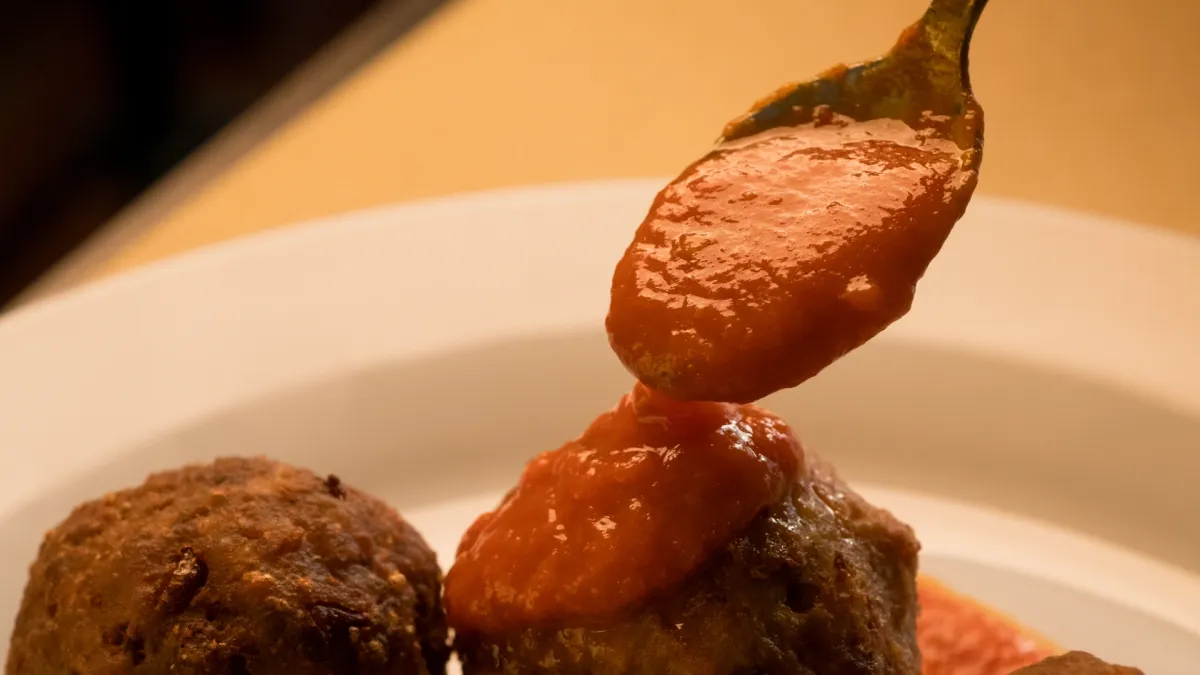
At Alla Cadrega, mondeghili enter the kitchen with the respect they deserve. The breading is golden to the right point thanks to cooking over medium heat, with the patience this dish requires. The result is a mahogany-colored crust, a soft and fragrant interior, a bite that tastes like the real Milan. We serve them as an appetizer, accompanied by our tomato sauce to dip them in!
FAQ — Questions about Mondeghili
Is it possible to book a table to eat them?
Yes. You can book directly from our website on the Book a Table page, or call us.
Are Mondeghili available for lunch?
Yes, Mondeghili at Alla Cadrega are available for both lunch and dinner. During the week, with the Business Lunch Menu they are served with a side of Roasted Potatoes or Grilled Vegetables.